 BACK
BACK Bright
 Dark
Dark Floral Print
 Multicolored
 White
White Pink
Pink Beige
Beige Red
Red Blue
Blue Green
Green Purple
 Black
Black Gold
Gold Silver
 Neutral
 BROWSE ALL DRESSES
How to Pose in a Long Train Dress – Tips for Non-Models
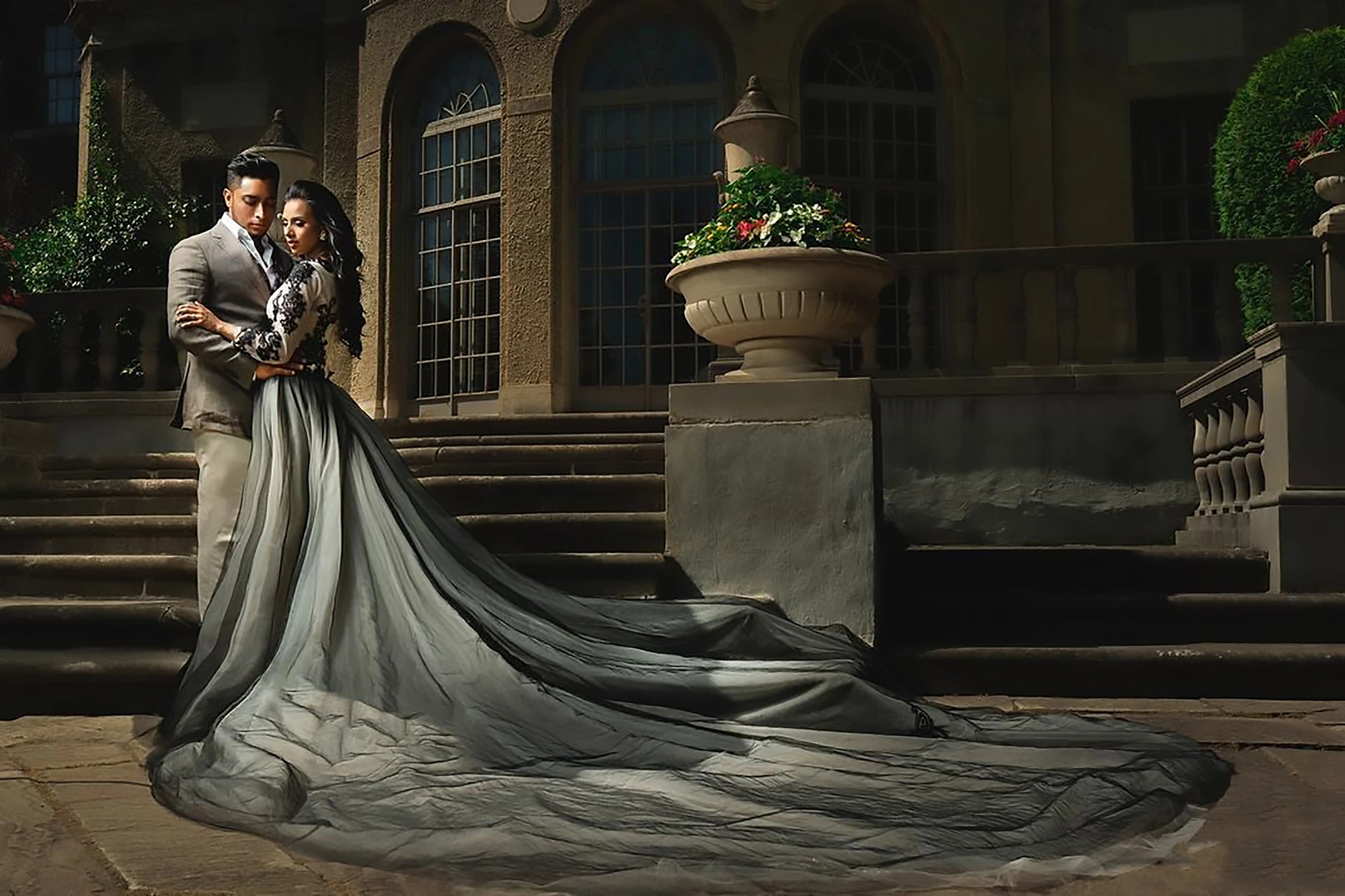
Here’s the fear we hear most often, almost word for word: “I’m not a model. I don’t know how to pose. What if I just look stiff in every photo?” Take a breath — that’s normal and it’s also fixable. Posing in a long-train gown isn’t about striking perfect model poses. It’s about understanding how the dress moves and giving the fabric something to do. Once you get that, the rest follows.
This guide isn’t a list of poses to memorize. It’s the practical version — what actually works for couples who’ve never done a photoshoot before, what to do with your hands, how to walk in a train without tripping and how to let the dress do most of the work for you.
Why Posing Feels Different in a Long-Train Gown
Most posing advice online is built around regular dresses or formal wear — stand here, tilt your chin, hold this angle. None of that fully applies once you’re wearing a gown with a train, because the train changes the physics of the shot. It’s not just fabric hanging behind you — it’s an active part of the composition that moves, drapes and catches light differently depending on what your body is doing. A pose that looks great in a short dress can look completely flat in a train because the train just sits there, lifeless, doing nothing.
The good news is this actually makes posing easier, not harder. Once you stop thinking about “how do I look” and start thinking about “what is the train doing,” a lot of the awkwardness disappears. The dress becomes the focal point and your job is mostly to give it room to move and let your body follow naturally. Every gown in our catalogue was designed with this in mind — long trains built specifically to flow, lift and spread when you move, not just trail behind you when you stand still.
The Basics: Stance, Hands and Where to Look
Before getting into specific poses, it helps to cover the three things that quietly affect almost every shot: how you’re standing, what your hands are doing and where your eyes are pointed. These sound small but they’re the difference between photos that feel natural and photos that feel posed in the bad sense. Most of the stiffness people worry about doesn’t come from the big dramatic moments — it comes from these small defaults running on autopilot. The fixes are simple once you know what to look for, and none of them require any experience in front of a camera. Here’s what to actually do with each one.
Stance — Wider Than You Think
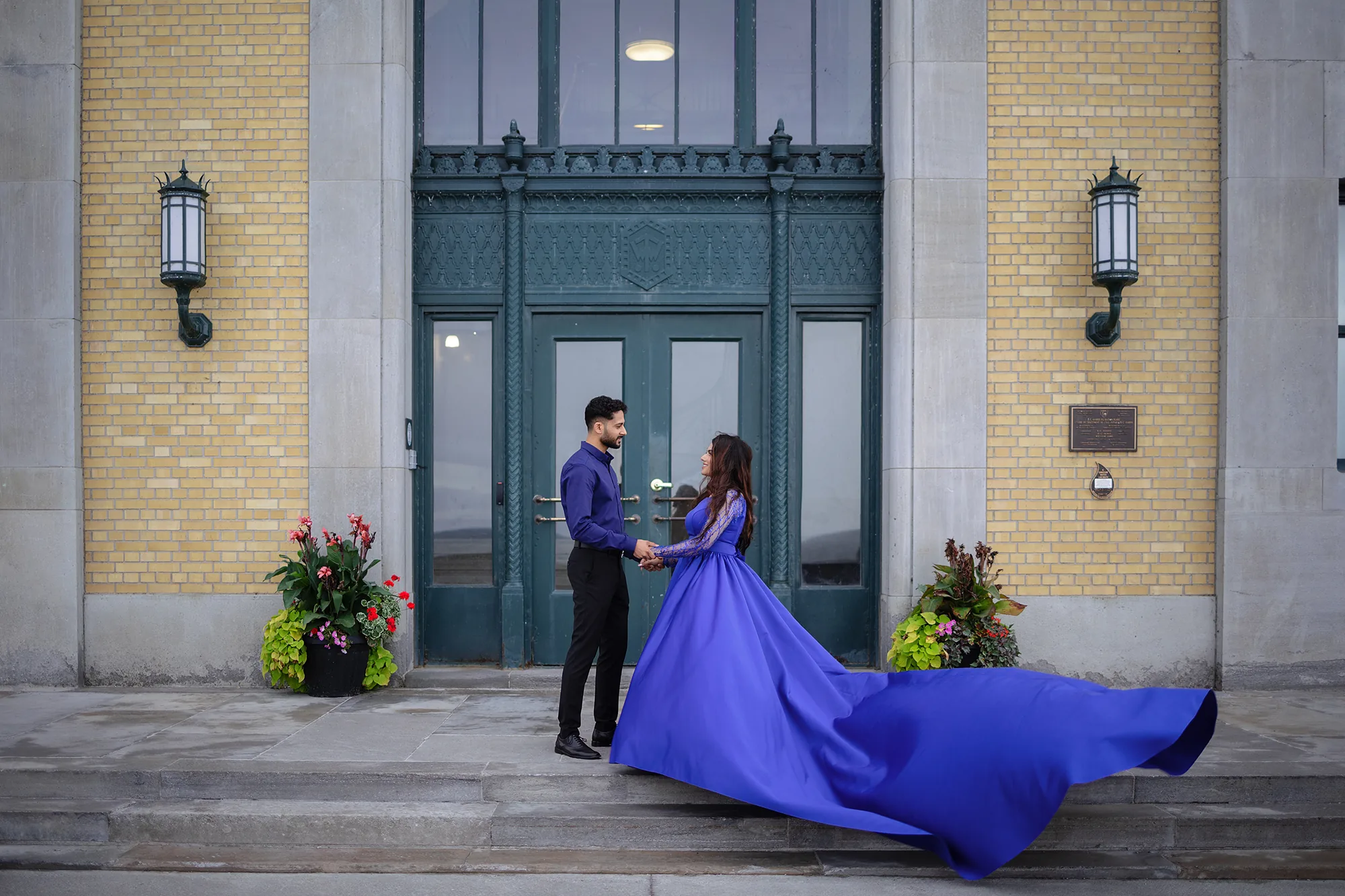
Most people’s instinct is to stand with feet close together, the way you’d stand for a regular portrait. With a train, this usually looks cramped. Try a wider stance than feels natural — weight slightly on your back foot, front foot pointed toward the camera or slightly angled. This opens up the silhouette and gives the train space to fall naturally rather than bunching up around your feet.
Hands — Give Them a Job
“What do I do with my hands” is the single most common question we get, full stop. The answer is: give them something to do. Hold the train slightly — even just a small section of fabric lifted at the side. Touch your partner’s hand, arm or face. Adjust your hair. Hold a bouquet if you have one. Hands that are doing something, even something small, read as natural. Hands that are just hanging at your sides read as stiff, every time.
Where to Look — Not Always the Camera
Looking directly at the camera works for some shots but it’s not the only option — and for engagement shoots specifically, it’s often not the best one. Looking at your partner, looking down at the dress, looking off into the distance — all of these create a sense of a moment happening rather than a portrait being taken. Save direct-camera eye contact for a handful of shots rather than every single one.
Working With the Train – Movement Is Everything
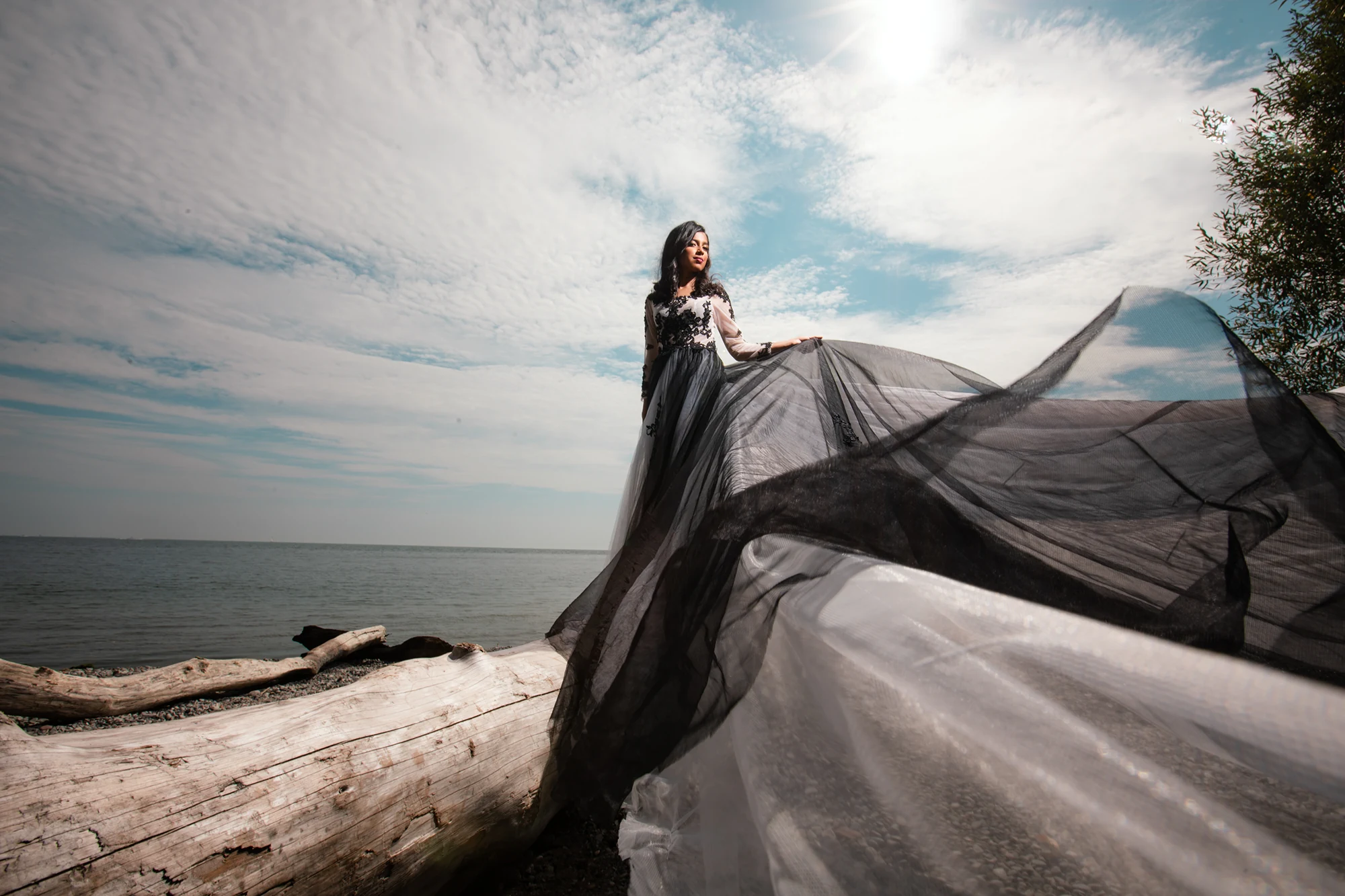
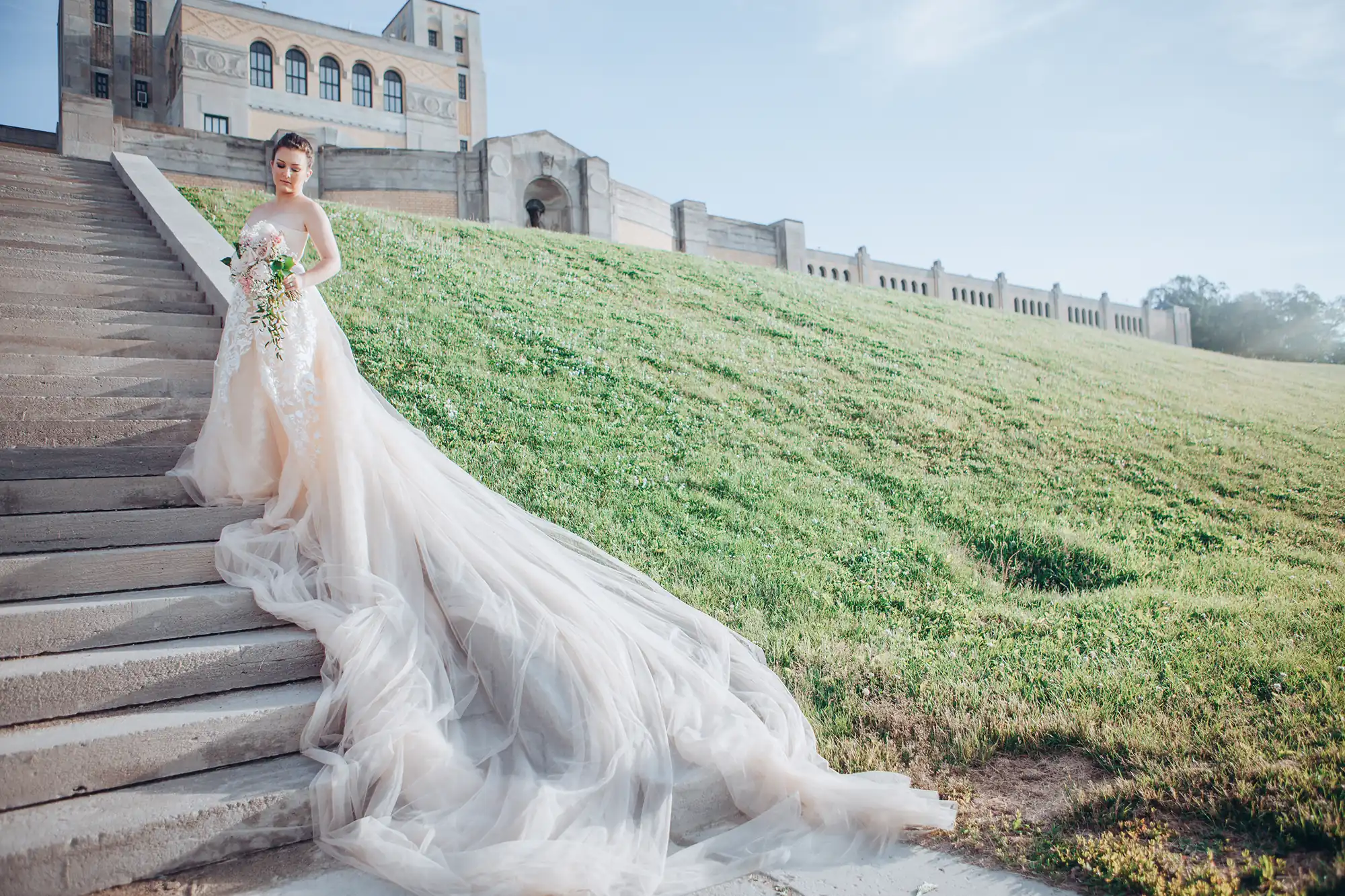
This is the part that makes the biggest difference and it’s also the part most people don’t think about until they’re standing in the dress. A train that’s just sitting on the ground does very little for a photo — it’s the movement that creates the drama. Walking, turning, spinning, even just shifting your weight from one foot to the other creates fabric movement that a static pose simply can’t replicate. The trains in our dress catalogue are built with enough fabric volume and the right materials specifically so that small movements translate into big visual results. None of this requires choreography — it’s closer to giving the photographer a series of moments to choose from rather than holding one perfect frame.
A few movement-based approaches that consistently work well:
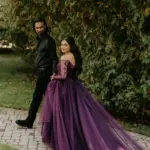
- The walk-away. Walk a few steps away from the camera and let the train drag and lift naturally behind you. Simple, almost foolproof and it photographs beautifully from behind.
- The turn. A slow turn — not a spin — lets the train sweep across the ground in an arc. This works especially well on grass, sand or smooth pavement where the fabric can slide rather than catch.
- The spin. For the full “flying dress” effect, a spin (or a partner spinning you) sends the train outward and up. This needs space and ideally a little wind, but it’s the shot most people picture when they imagine these photos.
- The sit or kneel. Lowering down lets the train pool around you in a way that’s impossible standing up. Great for fields, steps or any surface you don’t mind the fabric touching.
Posing With Your Partner
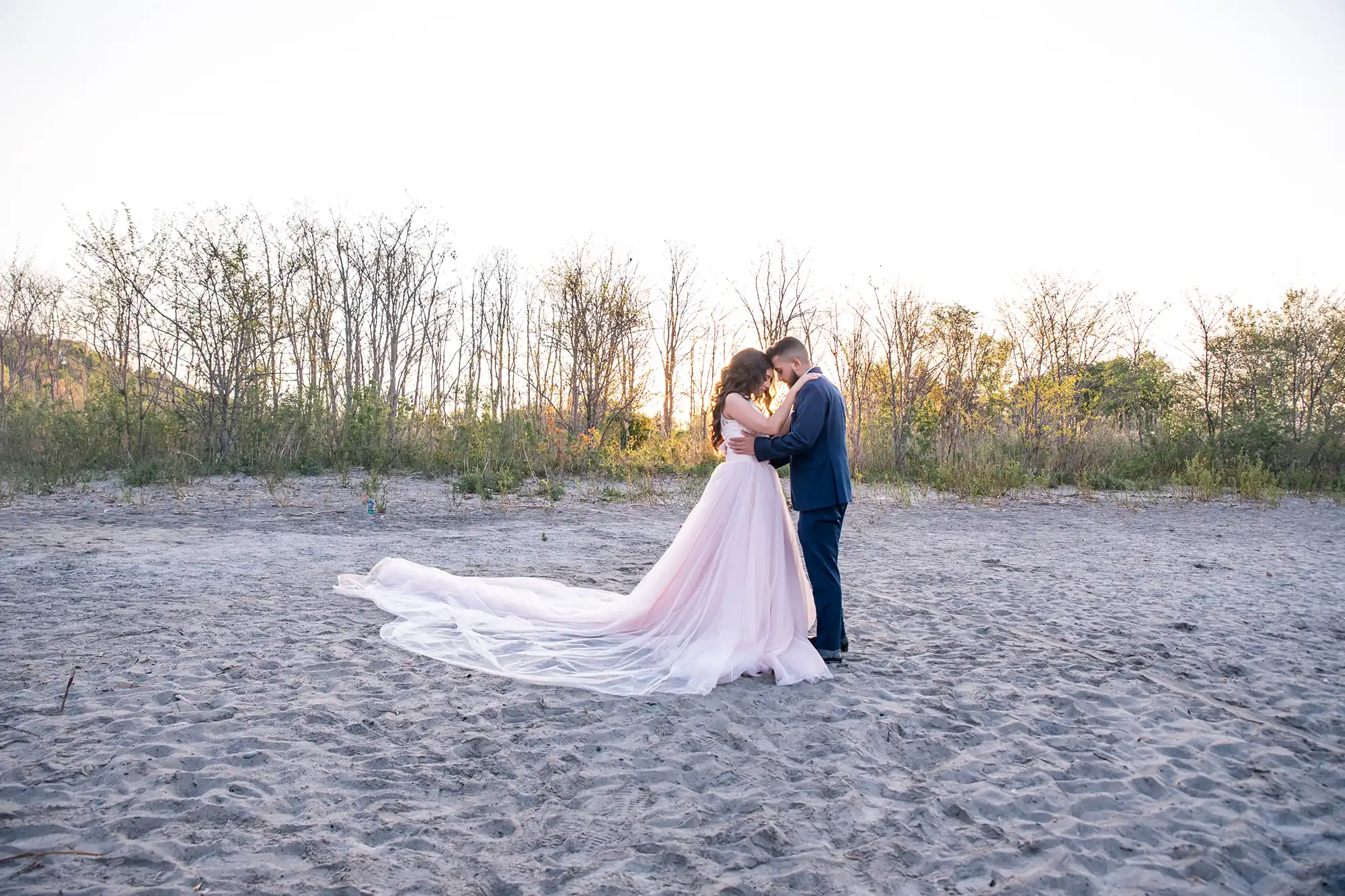
Couple poses in a long-train dress work a little differently than standard engagement poses, mostly because of where the train physically is. A classic face-to-face pose can end up with one partner standing directly on the train without realizing it — not a disaster, but worth being aware of. The easiest fix is simple positioning: have the train-wearer’s body angled slightly so the train falls to one side, away from where your partner is standing or walking.
Beyond that, most couple poses translate just fine — foreheads together, hand-holding, walking side by side, one partner slightly behind. The train just becomes another visual element your photographer can frame around.
A few combinations that work particularly well:
- Walking together, train behind. Natural, candid-feeling and the train trails beautifully if there’s any breeze at all.
- Partner lifting or holding part of the train. A small, intimate gesture that also solves the “what do I do with my hands” question for both people at once.
- One partner seated, train spread around them, the other standing or kneeling beside. Creates a nice height contrast and gives the fabric room to be the visual anchor.
Common Mistakes (And Quick Fixes)
A few things come up often enough that they’re worth calling out directly. None of these are a big deal — they’re just easy to miss until someone points them out.
- Standing on your own train. Especially during turns or when stepping backward. The fix is just awareness — take a small step to clear the fabric before moving.
- Forgetting the train exists in seated poses. If you sit down without arranging the train first, it can end up bunched underneath you rather than spread out. Take a second to pull it forward or to the side before settling in.
- Over-posing hands. Splayed fingers, overly dramatic gestures — these read as try-hard in photos even if they don’t feel that way in the moment. Relaxed and slightly engaged beats dramatic almost every time.
- Tension in the shoulders. This is the most common one and also the easiest to fix. If you feel stiff, drop your shoulders, take a breath and shake out your hands for a second before the next shot.
What If You Genuinely Have No Idea What to Do?
This is more common than you’d think, and it’s completely fine. Most people who’ve never done a photoshoot before don’t walk in with a plan — and they don’t need one. A good photographer will give direction, and a lot of the best shots come from movement prompts rather than static poses: “walk toward me,” “turn around slowly,” “look at each other and laugh about something.” The dress itself does a lot of the visual heavy lifting, which takes pressure off needing to “perform.”
If it helps, during your dress fitting we can also show you a few of these movements in the dress itself — how it falls, how it moves when you walk or turn — so it feels a little less unfamiliar on the day of your shoot.
About the designer
Helen Illumina is the self-taught designer behind Athena Dress Rental, creating couture gowns in Canada using premium fabrics sourced worldwide.
about us